
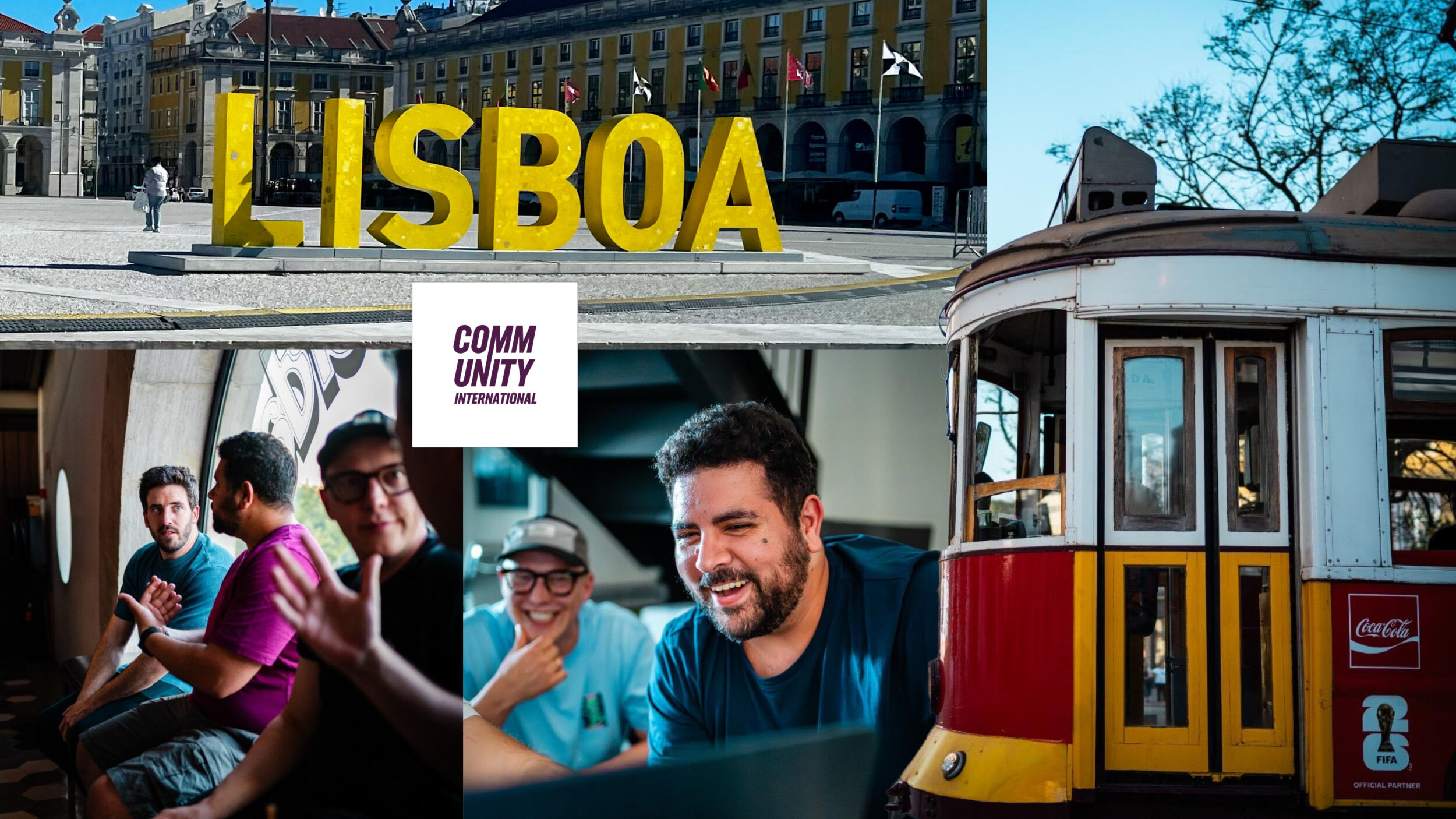
In June, Vincent and I traveled to Lisbon to participate in an AI hackathon organized by Community International, a network of independent digital agencies from across Europe. Two days, a good dozen presentations, and a lot to take in. It was my first time at one of these events, and I’ll admit: I wasn’t exactly sure what to expect. What I got was one of the most valuable professional experiences I’ve had in a long time.
These meetings thrive on radical transparency. Agencies speak openly about what really works and what doesn’t, without polished success stories or vendor pitches. Practitioners who lay their cards on the table with one another. In Lisbon, the topic was AI—and not just in theory.
The agency model is being rebuilt from the inside out
AI as a mere tool was no longer an issue in Lisbon. The focus was on how AI is reshaping the inner workings of companies: how teams are structured, who is still needed, and how work is actually getting done. For agencies that are in the midst of this transformation and are simultaneously helping their clients navigate it, this was particularly tangible.
The message was clear: Standing still leads to a slow death—even for a high-performing agency. Those who survive aren’t the ones who simply added an “AI layer” on top, but rather those who reimagined the model itself.
In practice, this means concrete restructuring: different roles, different responsibilities. It’s not just technical staff who build workflows and update AI assistants—it’s everyone on the team. The generalist with the right tools becomes more valuable than the narrow specialist.
Author’s Note: At husare, we embarked on this path early on. We held our first internal AI workshop in September 2023, and since then we’ve been actively driving transformation: through automation, data structures, AI assistants, and workflows that we develop both internally and for our clients. What we’ve gained from this is, above all, time and focus for what really matters: strategy, creativity, and the human interaction that makes good work possible in the first place. AI implementation opens doors that a traditional performance pitch wouldn’t. When implemented correctly, it forces the right conversations: How is information really structured within this company? Who owns what data, and how does knowledge flow between departments? These questions reveal governance gaps and process issues that have quietly accumulated over the years. AI work becomes a catalyst for something much more fundamental.
Where Work Is Really Changing
A pattern emerged over the course of several sessions: The role of humans in agency work is shifting from creator to critic. When agents do the work, humans become the judges of that work, and that creates room for greater ambition. One is no longer limited by execution capacity. But there’s a catch: sound judgment is a prerequisite. Without critical thinking and intuition, agent-based work is a gamble, not a system.
The same applies to sales. One agency demonstrated a fully AI-powered sales pipeline in which a personalized outreach draft—including company research, competitive analysis, and LinkedIn analysis—is ready within ten minutes of receiving a lead. This isn’t some future workflow. It’s already up and running.
The same applies to creative production. With AI-powered asset pipelines, visual worlds and scenarios can be created in a fraction of the time that would have taken days in the past. The human role is now focused on briefing, selection, and approval.
GEO (Generative Engine Optimization) was also a recurring topic, both as a service and as a sales tool. Generating a live GEO readiness report during a sales call and sending the results immediately afterward was cited as one of the most effective sales tactics in the room.
Author’s Note: The speed at which AI can produce a competitive analysis, a GEO audit, or a channel performance evaluation is very real. But a quick analysis is not a strategy. Knowing what really matters, what to prioritize, and how to translate insights into decisions that are tailored to a specific company—that remains a human task. And that is precisely where the value lies.
Where AI Excels — and Where It Doesn’t
Performance-driven campaigns benefit particularly strongly from AI. They are based on a comprehensive database, are measurable, and can be continuously optimized. AI can identify patterns, accelerate processes, and free up resources that were previously tied up in operational execution.
When it comes to long-term brand growth, the picture is different. Strong brands are built on bold decisions, unexpected collaborations, a keen sense of design and social movements, an eye for trending colors and shifts in mood—things that are changing before they show up in data. AI cannot do this because its data is always based on what already exists. It recognizes patterns, but it does not create meaning. Our core business has been and remains the creation of new things, and that is precisely where the human touch comes in.
The AI–Diamond
One of the most memorable concepts from the two-day event was the AI Diamond, a model that describes how AI is fundamentally transforming organizational structures.
The traditional agency model has a hierarchical structure: executive leadership, management, specialists, and operational execution. The AI Diamond describes a compression of this model from the bottom up. AI is increasingly taking over the operational execution level, while middle management is undergoing a transformation. It is becoming the layer responsible for AI-driven results and for taking corrective action where necessary.
Human labor isn’t going away. Its focus is shifting. The more operational tasks are automated, the more important it becomes to have people who understand and manage systems and make the right decisions.
What We’re Taking With Us
Lisbon confirmed some of what we already thought and clarified some of what we hadn’t yet fully articulated. The agencies that are truly making progress aren’t waiting for AI to stabilize before taking action. They act before the market forces them to, and openly share what they’re learning along the way. Those that are falling behind treat AI as a feature to be added, rather than a transformation that must be navigated.
AI is only as good as the context it has access to. This means that structured corporate knowledge becomes the very foundation of any AI strategy. It must be organized in such a way that AI can access it effectively without compromising data security or governance. Before building complex workflows, this foundation must be in place. Those who understand this early on are building on something resilient. Those who ignore it will find that even the best AI systems can only think as structurally as the data they work with.
That’s the starting point for what we’re working on next at husare. More on that in the coming weeks.