
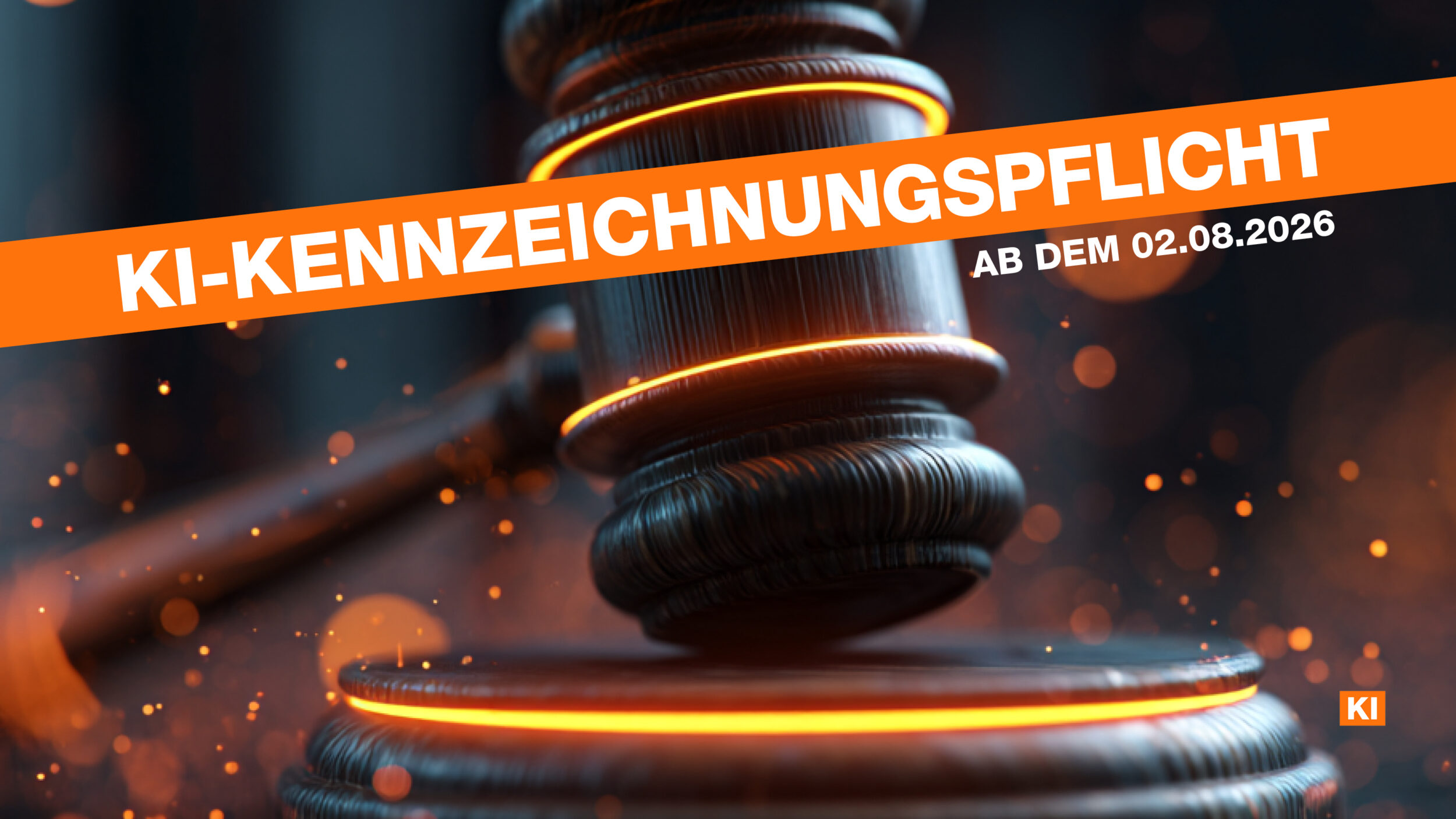
Starting August 2, 2026, new transparency requirements will apply across Europe to certain AI applications. These requirements are based on Article 50 of the EU AI Act. The goal is to inform people when they interact with AI or are exposed to content that may be deceptive, manipulative, or imitate a real person.
For companies, this means that the use of generative AI should now be systematically evaluated and integrated into clear processes. It is important to take a nuanced approach here. Not all AI-generated content needs to be automatically labeled as such.
What are the new guidelines about?
Article 50 of the EU AI Act distinguishes between providers and operators of AI systems. Providers develop or make AI systems available. Among other things, they must ensure that AI-generated or manipulated content is identifiable in a machine-readable format. Operators use AI systems in their day-to-day work, for example, for communication, content production, customer service, or marketing. They are subject to specific disclosure requirements, particularly when individuals are exposed to certain AI-generated content.
The regulations will take effect on August 2, 2026. The European Commission has published guidelines on this matter; in addition, a voluntary code of conduct is intended to support practical implementation.
When is labeling required?
Two cases are particularly relevant:
Deepfakes
Anyone who publishes AI-generated or AI-manipulated image, audio, or video content that could be mistaken for real or authentic must disclose that the content is artificially generated or altered. This applies, for example, to content in which real people appear to say or do something that never actually happened, including imitated voices.
The information must be clear, understandable, and recognizable no later than the first time the user encounters the content.
AI-generated texts on topics of public interest
Disclosure may also be required for texts: specifically, when an AI system publishes content intended to inform the public about matters of public interest, and no effective human review or editorial oversight has taken place.
The decisive factor is not merely whether AI was used in the creation of the text. A disclosure requirement generally does not apply if a responsible person has reviewed the text’s content and assumes editorial responsibility. A purely formal or superficial review is not sufficient for this purpose.
What are the rules for AI-generated images in marketing and advertising?
The legal situation is often oversimplified: Article 50 does not provide a basis for a blanket statutory “AI-generated” label for every AI-generated marketing image.
The statutory disclosure requirements for operators focus in particular on deepfakes. For traditional advertising imagery that is not deceptive, the specific circumstances of each individual case are therefore always decisive—such as the design, the context, the audience’s expectations, and other applicable regulations, for example under competition or consumer law.
This generally does not include standard editing techniques such as color and brightness corrections, sharpening, noise reduction, or the removal or blurring of backgrounds. The key factor is whether the use of AI creates or alters content that could give the audience the impression of a real and authentic situation.
Regardless of the legal minimum requirement, voluntary labeling can be beneficial. It promotes transparency, builds trust, and helps establish consistent standards within the company.
What should the labeling look like?
The EU AI Act does not prescribe a specific wording for operators. However, the information must be clear, easily noticeable, and understandable to the individuals concerned. In the case of deepfakes, the disclosure should be placed directly in the advertising material or in its immediate vicinity—not hidden in a footnote or exclusively in the metadata.
Depending on the content, notes like these, for example, may be appropriate:
- “AI”
- “AI”
- “AI-generated”
- “Created with AI”
- “Transformed by AI”
- “AI-generated or AI-manipulated”
Platform-specific AI labels can also be a useful addition, provided they are clearly recognizable to the target audience. In the case of deepfakes, the label should be placed directly on the content or in its immediate vicinity—not hidden in a footnote or exclusively in the metadata.
What Companies Should Do Now
The deadline is approaching. Companies should therefore not wait until August 2026 to organize their use of AI, but should establish clear responsibilities and processes now.
1. Supplement briefings
Determine at the start of the project whether and to what extent AI will be used.
2. Pre-Check Before Publication
Check before publication: Is a real or plausibly real person, voice, location, or product being depicted using AI in a way that could give the audience a false impression of authenticity?
3. Choose a label:
If the content is a deepfake, include a visible or audible notice directly in the advertisement. Suitable labels include, for example, “AI-generated,” “Created with AI,” “Modified with AI,” “AI,” or “AI.”
4. Define Responsibilities
Clearly define in the project plan who will perform the AI classification, who will implement the labeling, and who will document the final approval.
5. Document borderline cases
In cases of doubt, document the reasons for your classification in writing, taking into account factors such as the target audience, channel, and context of the publication.
Transparency is more than just an obligation
The new regulation is not a cause for unnecessary bureaucracy. It is an opportunity to organize the use of AI, approval processes, and transparency within the company in a clear and responsible manner.

Would you like to find out what the new transparency requirements mean for your company, your communications, or your content production?
Jule Giese is your contact at husare for questions regarding AI labeling and the responsible use of generative AI.
Get in touch with Jule at j.giese@husare.de
Legal Notice
This article is intended as a general guide and is not a substitute for legal advice. Whether a disclosure requirement applies depends on the content, context, target audience, and method of publication. In borderline cases, it is advisable to seek legal review.
Sources: Article 50 of the EU AI Act; European Commission Guidelines on Transparency Requirements for Providers and Operators of Certain AI Systems, available from the European Commission. The guidelines clarify the application of the provision but do not themselves constitute the text of the law.